- What Kind of Clean Environment Does an IVF Laboratory Need?
- Which Standards and Guidelines Are Used in IVF Laboratory Design?
- What Is a Clean Zone in an IVF Laboratory and Where Is It Located?
- What Principles Should Be Used to Design Airflow in an IVF Laboratory?
- IVF Laboratory Zoning: From Patient Reception to the Embryology Laboratory
- IVF Laboratory HVAC: The Foundation for Stable Air Quality
- ACH in IVF Laboratories: How Many Air Changes per Hour Are Appropriate?
- HEPA in IVF Laboratories: Excellent Particle Filtration, but Not Enough by Itself
- VOCs: A Critical IVF Laboratory Risk That HEPA Cannot Solve
- Differential Pressure in IVF Laboratories: Why Is Positive Pressure Commonly Used?
- How Do Supply and Return Air Locations Affect the Clean Zone?
- How Should Temperature, Humidity, and Airflow Work Together?
- IVF Laboratory Construction and Finishing: Building Materials Also Affect Air Quality
- Commissioning and Airflow Testing Before the IVF Laboratory Begins Operation
- FAQ – Frequently Asked Questions About Airflow and Clean Zones in IVF Laboratories
- Conclusion: A Clean Zone in IVF Must Be Created by the Entire System
In an IVF laboratory, air quality is not simply about how clean the room looks or feels. Oocytes, sperm, and especially embryos are handled outside the human body for certain periods of time, which means they may be affected by temperature, air quality, volatile chemical compounds, particles, microorganisms, and environmental fluctuations occurring directly around the working area.
For this reason, IVF laboratory design should not begin only with questions such as “How many HEPA filters are needed?” or “Which ISO Class should the room achieve?” A properly designed system should be considered as a complete chain:
Zoning → Airflow → Clean Zone → HVAC → HEPA → VOC Control → Differential Pressure → Temperature and Humidity → Monitoring → Commissioning
This is also what makes an IVF laboratory different from many industrial cleanrooms. In an electronics facility, airborne particles may be the primary concern. In an IVF laboratory, particles are only one part of the problem. The chemical quality of the air, temperature stability, equipment layout, and the amount of time oocytes or embryos spend outside the incubator are also critically important.
What Kind of Clean Environment Does an IVF Laboratory Need?
IVF – In Vitro Fertilization is an assisted reproductive technology in which fertilization between an oocyte and sperm takes place outside the human body. After retrieval, oocytes may undergo identification, preparation, fertilization, culture, assessment, cryopreservation, or transfer back into the patient.
Most of these procedures take place in an IVF Laboratory or Embryology Laboratory, which is a specialized laboratory for handling reproductive cells and embryos.
This is not an ordinary diagnostic laboratory. Oocytes, sperm, and embryos are manipulated directly using microscopes, pipettes, culture dishes, and other highly specialized equipment.
Unlike conventional laboratory specimens, oocytes and embryos are highly sensitive biological materials. Therefore, the purpose of environmental control is not only to reduce visible dust but also to maintain a stable environment and minimize unnecessary environmental stress during handling and culture.
Important environmental factors may include airborne particles, microorganisms, temperature, humidity, gas quality, the purity of gases supplied to incubators, and especially VOC – Volatile Organic Compounds.
VOCs may come from paint, adhesives, construction materials, furniture, cleaning agents, cosmetics, perfume, packaging materials, or outdoor pollution.
This is particularly important in IVF because HEPA filtration is very effective at controlling particles but is not designed as the primary method for removing gaseous chemical contaminants.
The concept of a Clean Zone should also be understood correctly.
A Clean Zone does not necessarily mean that the entire IVF laboratory must have the same level of environmental control at every location.
Some areas where oocytes or embryos are directly handled may require greater local protection than the surrounding laboratory background.
The European Society of Human Reproduction and Embryology – ESHRE, in its updated 2026 recommendations for good practice in IVF laboratories, emphasizes control of air quality through HEPA filtration, VOC control, positive pressure, sufficient fresh-air supply, and risk-based assessment of air cleanliness.
The correct question is therefore not simply:
“How clean should an IVF laboratory be?”
It should be:
What risk needs to be controlled in each area, and what engineering mechanism should be used to control it?
Which Standards and Guidelines Are Used in IVF Laboratory Design?
There is no single international standard that provides a complete HVAC design for every IVF laboratory.
IVF facilities generally need to consider national regulations, requirements from healthcare authorities, specialized assisted-reproduction guidelines, and cleanroom standards where appropriate.
One of the most important specialist references is the ESHRE Recommendations on Good Practice in the IVF Laboratory.
The updated ESHRE recommendations published in 2026 provide guidance on laboratory layout, environmental control, equipment, procedures, risk management, and air quality.
ESHRE recommends controlling laboratory air with both HEPA filtration and VOC control.
It also recommends maintaining positive pressure to reduce contamination from surrounding areas, providing sufficient fresh air, and evaluating cleanliness based on risk in both resting and operational conditions.
At Rest refers to a condition in which the HVAC and technical systems are operating but normal personnel activity is absent or significantly reduced.
In Operation refers to the condition in which staff and equipment are operating under normal working conditions.
This distinction is important because a room may have very low particle counts when unoccupied but significantly higher contamination levels when personnel are moving, doors are opening, and equipment is operating.
In the United States, the American Society for Reproductive Medicine – ASRM also publishes recommendations for embryology laboratories.
ASRM discusses the use of dedicated clean-air systems, HEPA filtration, activated carbon, permanganate-based filtration, or similar chemical air-cleaning strategies to control particulate and gaseous contaminants.
It also recommends positive air pressure in embryology laboratories relative to appropriate adjacent spaces.
In addition to specialist IVF guidance, ISO 14644-1:2015 can be used when a facility needs to classify airborne particle cleanliness.
ISO 14644-1 defines cleanrooms and clean zones according to airborne particle concentrations.
However, ISO itself makes clear that this standard does not describe the chemical, biological, or viable nature of those particles.
This explains why an IVF laboratory may meet a particular ISO Class but still have air-quality conditions that are not ideal for embryos.
ISO Class mainly answers the question of particle concentration.
IVF laboratory design must also address VOCs, temperature, gases, airflow, and environmental stability.
What Is a Clean Zone in an IVF Laboratory and Where Is It Located?
A Clean Zone is a controlled area designed to maintain contaminants within limits appropriate for the activity performed there.
In an IVF laboratory, a Clean Zone can be understood at two levels:
the controlled background environment of the entire laboratory and the more highly protected local area where oocytes or embryos are directly handled.
For most of the culture period, embryos are protected inside an Incubator, where temperature, gas composition, and culture conditions are controlled.
However, embryos must be removed from the incubator for certain procedures such as examination, dish transfer, or other embryology operations.
At these moments, the environment around the workstation becomes particularly important.
An Embryology Workstation is the working area where embryologists handle oocytes, sperm, embryos, and culture dishes.
The workstation often includes a microscope, heated work surface, and specialized handling tools.
Some laboratories use a Laminar Flow Hood, a workstation designed to provide filtered air in a relatively uniform direction across the critical work area.
The purpose of this airflow is to reduce the entry of particles from the surrounding environment.
However, airflow from the Laminar Flow Hood does not operate independently of the room HVAC system.
If the room supply diffuser blows strongly toward the workstation, the background airflow may interfere with the protective airflow at the work surface.
Similarly, if the return grille is placed too close to the workstation and creates excessive suction, the actual airflow pattern may differ from the intended design.
ESHRE recommends that manipulation of biological materials be performed efficiently in controlled conditions and that heated surfaces such as a Heated Stage or Tube Warmer be used where appropriate to maintain stable temperatures during handling.
A Heated Stage is a temperature-controlled working surface used under a microscope or at a workstation.
A Tube Warmer is a device used to maintain the temperature of sample tubes or culture materials.
Therefore, a Clean Zone in IVF is not simply a rectangle marked on a drawing.
It is the result of interaction between filtered air, equipment, temperature control, personnel position, and overall room airflow.
What Principles Should Be Used to Design Airflow in an IVF Laboratory?
Airflow describes the direction and movement of air within a space.
It is one of the most important aspects of IVF laboratory design, but also one of the easiest to oversimplify.
The system normally includes Supply Air, which is treated air delivered into the room; Return Air, which is collected and returned to the HVAC system; and, in some systems, Exhaust Air, which is removed from the room or discharged outside the building.
The objective is not simply to supply as much clean air as possible.
Air should be distributed so that critical areas receive treated air before that air is removed through return points.
One common problem is Short Circuit Airflow.
Short Circuit Airflow occurs when air leaves a supply diffuser and is immediately drawn into a nearby return grille without adequately passing through the occupied or critical area.
Another problem is a Dead Zone.
A Dead Zone is an area with poor air circulation, which may occur behind large equipment, under tables, or in corners when the supply and return arrangement is poorly designed.
Another concept is Turbulence, meaning irregular or highly disturbed air movement.
In a real laboratory, airflow is influenced by personnel movement, door opening, heat from equipment, and airflow generated by workstations.
In an IVF laboratory, reducing excessive turbulence around the embryo-handling area may be more important than simply increasing air velocity.
For example, placing a supply diffuser directly above the workstation may initially seem beneficial because clean air is delivered directly to the critical area.
However, if the air velocity is too high, it can create a Draft, meaning an undesirable local air current, which may interfere with thermal stability or disturb the airflow pattern of the workstation.
People are also important sources of particles and airflow disturbance.
When an operator walks between a supply diffuser and a workstation, the person's body becomes an obstacle that changes the airflow pattern.
When several staff members stand around one workstation, actual airflow may be very different from the empty-room condition.
A good airflow design should therefore answer three basic questions:
Where does clean air enter? Which zones does it pass through? Where is it collected or returned?
IVF Laboratory Zoning: From Patient Reception to the Embryology Laboratory
Functional Zoning means organizing rooms according to their function, environmental requirements, and risk level.
An IVF laboratory should not be considered as a single isolated room.
Its location within the overall fertility center directly affects the transport distance for oocytes, sperm, and embryos.
The Oocyte Retrieval Room is the procedure room where oocytes are collected from the patient.
Once retrieved, the oocytes should be transferred promptly to the embryology laboratory for identification and processing.
The Embryo Transfer Room is the room where embryos are transferred back into the uterus.
Because both procedures involve the direct movement of reproductive cells or embryos, the location of these rooms relative to the Embryology Laboratory should be carefully considered during planning.
ESHRE recommends that the IVF laboratory be located conveniently for the transfer of reproductive cells and that activities involving cleaning, disinfection, or potentially harmful chemicals be separated from the main laboratory environment.
The Andrology Laboratory is the laboratory where semen and sperm-related procedures are performed.
ASRM notes that the andrology laboratory does not necessarily require exactly the same air-quality conditions and facility design as the embryology laboratory, although clean technique and appropriate environmental control remain important.
The Cryostorage Room is the area where cryogenic tanks containing liquid nitrogen are used to store frozen embryos, oocytes, or sperm.
Cryostorage has its own safety requirements and does not necessarily need to be located inside the main Embryology Laboratory.
ASRM recommends placing gas cylinders and liquid nitrogen tanks in adjacent or nearby spaces rather than directly inside the embryology laboratory.
The washing area should also be separated from the embryo-handling zone.
Water, drains, cleaning procedures, and cleaning chemicals may create additional sources of contamination.
ESHRE similarly recommends separating cleaning and sterilization activities from the IVF laboratory.
A good IVF layout therefore does not simply minimize the number of rooms.
It minimizes unnecessary crossing between personnel, reproductive samples, supplies, chemicals, and waste.
IVF Laboratory HVAC: The Foundation for Stable Air Quality
HVAC – Heating, Ventilation and Air Conditioning is the system responsible for treating and distributing air within the IVF laboratory.
In a centralized system, air is commonly processed through an AHU – Air Handling Unit.
An AHU may include filtration stages, cooling coils, heating coils, fans, humidity-control components, and other equipment depending on the system design.
Air taken from outside the building is called Outdoor Air or Fresh Air.
Fresh air is important because it dilutes contaminants generated inside the room.
However, outside air itself can become a source of pollution if the air intake is poorly located.
Fresh-air intakes should therefore not be placed where they may draw in exhaust fumes from parking areas, generators, kitchens, chemical rooms, or other pollution sources.
Air collected from the room and sent back to the AHU is called Return Air.
When some of this return air is treated and reused, it becomes Recirculated Air.
In IVF laboratories, recirculated air must be carefully evaluated because of VOC risks.
If the same return-air system is shared with spaces that generate chemicals, odors, or cleaning-agent vapors, gaseous contaminants may be redistributed into the IVF laboratory.
This is why ASRM recommends dedicated clean-air supply systems for embryology laboratories and consideration of HEPA filtration combined with activated carbon, permanganate, or similar air-cleaning technologies.
The HVAC system must also maintain stable temperature and humidity.
Incubators, microscopes, lighting, computers, and staff all generate heat.
If the heat load is underestimated, room temperature may fluctuate even when the air-conditioning system appears to be operating normally.
Another important concept is Redundancy, meaning backup capacity or a backup system that can continue supporting critical operations if the primary system fails.
IVF laboratories contain sensitive biological materials and highly specialized equipment.
For this reason, critical elements such as electrical power, incubator gases, or environmental-control systems may require redundancy depending on the facility's risk assessment.
HVAC should therefore not be viewed merely as a system for cooling the room.
It is the foundation that allows HEPA filtration, VOC control, positive pressure, and Clean Zones to function consistently.
ACH in IVF Laboratories: How Many Air Changes per Hour Are Appropriate?
ACH – Air Changes per Hour describes how many times an amount of air equal to the room volume is supplied or circulated during one hour.
A simplified example:
If a room has a volume of 100 m³ and receives 1,500 m³/h of air, the equivalent air-change rate is approximately 15 ACH.
ACH is useful because it gives designers a general indication of how much air is being circulated through the room.
However, ACH does not describe the actual direction of airflow.
A room operating at 20 ACH may still perform poorly if most of the supply air travels directly into the return grille without properly passing through the critical area.
In an IVF laboratory, airflow quantity should be evaluated together with the number of personnel, equipment heat load, VOC generation, room size, workstation location, and fresh-air requirements.
ESHRE recommends providing sufficient fresh-air changes but does not prescribe a single universal ACH value for every IVF laboratory.
This is consistent with a risk-based design approach.
Increasing ACH may be beneficial because it can dilute contaminants and improve Recovery Time.
Recovery Time is the time required for the room environment to return to an acceptable cleanliness condition after contamination levels temporarily increase.
However, excessive ACH may increase air velocity, create airflow turbulence around workstations, increase noise, increase cooling load, and significantly increase energy consumption.
The question should therefore not simply be:
“Should the IVF laboratory operate at 15, 20, or 30 ACH?”
A more useful question is:
At this airflow rate, is the Clean Zone stable? Are VOCs adequately diluted and controlled? Is positive pressure maintained? Is temperature stable?
HEPA in IVF Laboratories: Excellent Particle Filtration, but Not Enough by Itself
HEPA – High Efficiency Particulate Air Filter is one of the most important devices used to control airborne particles in IVF laboratories.
HEPA filters are designed to capture very small particles from the air stream with high efficiency.
They can therefore significantly reduce particulate contamination delivered into the laboratory.
Airborne microorganisms are often carried on larger particles or droplets, so controlling particles through HEPA filtration can also contribute to reducing microbial contamination.
However, HEPA filtration is not a complete solution.
HEPA filters mainly remove physical particles.
They are not designed as chemical filters for most gaseous VOC contaminants.
In IVF HVAC systems, HEPA filters may be installed inside the AHU or near the laboratory as Terminal HEPA Filters.
A Terminal HEPA Filter is installed close to the final air-supply point, reducing the length of ductwork downstream of the final filtration stage.
A HEPA Box is a ceiling-mounted terminal housing containing a HEPA filter and connected to the supply-air duct.
Depending on the design, it may include a diffuser, differential-pressure test ports, and filter-testing access points.
Another option is an FFU – Fan Filter Unit.
An FFU combines a fan and HEPA filter into a single ceiling-mounted module.
FFUs may be suitable for layouts that require distributed clean-air supply or local control of airflow.
HEPA filtration may also be integrated into Laminar Flow Workstations to create a clean local airflow around the embryo-handling area.
A common question is whether H13 or H14 HEPA should be selected.
The decision should not be made only because H14 has a higher classification number.
The filter class should be selected according to the required cleanliness level, airflow, pressure drop, fan capacity, and overall HVAC strategy.
After installation, the filter may also require an Integrity Test.
An integrity test verifies that there are no unacceptable leaks through the filter media, gasket, housing, or installation.
HEPA is therefore very important, but it should always be considered as part of a broader system:
HEPA + Airflow + VOC Control + Pressure + Clean Zone + Operation
VOCs: A Critical IVF Laboratory Risk That HEPA Cannot Solve
VOC – Volatile Organic Compounds are chemical compounds that can evaporate into the air under normal indoor conditions.
This is one of the major factors that distinguishes IVF laboratory design from many cleanroom applications that mainly focus on particles.
VOC sources may originate directly from the building.
Wall paint, adhesives, sealants, vinyl flooring, new furniture, and some synthetic construction materials may release organic chemicals into the indoor air.
The process by which new materials continue to release vapors after installation is called Off-gassing.
This is why ESHRE recommends allowing sufficient time for new or renovated IVF laboratories to undergo off-gassing before routine use.
Construction materials, paint, flooring, and furniture should also be selected to minimize VOC emissions and potential embryo toxicity.
VOC sources are not limited to construction materials.
Perfume, cosmetics, cleaning agents, solvents, photocopiers, plastic packaging, and polluted outdoor air may also affect laboratory air quality.
HEPA filtration does not primarily remove these gaseous contaminants.
Activated Carbon is a high-surface-area material commonly used to adsorb many gaseous contaminants.
Some filtration systems also use media containing Potassium Permanganate, which can chemically react with certain airborne contaminants.
These technologies are generally described as Chemical Filtration.
Another commonly used term is TVOC – Total Volatile Organic Compounds.
TVOC represents the combined concentration of multiple volatile organic compounds.
It can be useful for monitoring overall trends but does not necessarily identify every individual compound present.
For this reason, ESHRE recommends considering Trend Analysis of VOC levels over time.
Trend Analysis means tracking environmental measurements over time to identify gradual changes rather than relying only on one isolated measurement.
This is important because one VOC measurement that meets an internal acceptance level does not mean the laboratory will remain stable indefinitely.
The facility needs to monitor whether air quality is stable, improving, or deteriorating.
Differential Pressure in IVF Laboratories: Why Is Positive Pressure Commonly Used?
Differential Pressure is the difference in air pressure between two spaces.
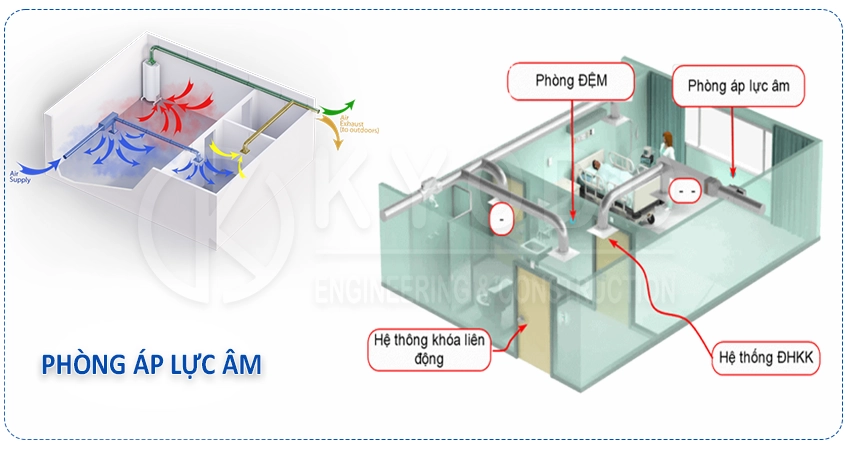
When a room has higher pressure than the corridor, it is called a Positive Pressure Room.
When doors are closed but small leakage paths remain, air tends to move from the higher-pressure room toward the lower-pressure area.
This principle is suitable for IVF laboratories because the objective is generally to reduce the entry of less-controlled air from corridors or adjacent spaces.
ESHRE recommends positive pressure to reduce contamination from outside the laboratory.
ASRM also recommends maintaining positive air pressure in embryology laboratories relative to appropriate adjacent rooms.
However, positive pressure is not created simply by “increasing the supply fan.”
The pressure relationship results from the balance between Supply Air, Return Air, Exhaust Air, and room airtightness.
If the room envelope is very leaky, the HVAC system may need to supply a large airflow surplus just to maintain a small pressure differential.
When several connected rooms are maintained at different pressure levels, the arrangement is called a Pressure Cascade.
A Pressure Cascade is a sequence of pressure levels designed to create a controlled airflow direction between spaces.
For example, the IVF laboratory may be maintained at a higher pressure than a transition zone, which in turn is maintained at a higher pressure than the corridor.
This is only an example of the airflow principle and should not be treated as a universal pressure value for every IVF facility.
A Differential Pressure Gauge can be installed to display the pressure difference between two rooms.
A Pressure Transmitter is an electronic device that converts pressure differential into a signal that can be transmitted to a monitoring system.
The system may then generate an alarm if pressure falls outside the defined range.
Positive pressure does not replace HEPA filtration or VOC control.
If the supply air itself contains chemical contamination, positive pressure may simply distribute that contaminated air outward.
Differential pressure is therefore only one layer of the complete air-quality strategy.
How Do Supply and Return Air Locations Affect the Clean Zone?
In conventional HVAC drawings, supply and return diffusers may sometimes be distributed mainly according to geometric spacing.
For an IVF laboratory, this is not sufficient.
Supply and return positions should be coordinated with the actual layout of workstations, incubators, microscopes, equipment cabinets, doors, and operator working positions.
If a supply diffuser is located too close to a return grille, Short Circuit Airflow may occur.
If a return grille is blocked by large equipment, a Dead Zone may develop behind the equipment.
If supply air is discharged at excessive velocity directly onto a workstation, a Draft may disturb the local Clean Zone.
Incubator location also needs to be considered carefully.
When an incubator door is opened, the controlled internal environment temporarily interacts with the room.
Placing the incubator immediately beside a frequently opened door or in a high-velocity airflow path may create a less stable surrounding environment.
Microscopes and workstations also act as large physical obstacles to airflow.
The operator's body creates another obstruction.
For this reason, the air-distribution plan should be coordinated with the equipment layout rather than completed independently before the laboratory equipment arrangement is known.
For complex projects, designers may use CFD – Computational Fluid Dynamics.
CFD is a computer-based method used to simulate fluid and airflow movement based on room geometry, supply and return positions, heat loads, and boundary conditions.
CFD does not replace actual testing, but it can help identify potential recirculation zones or poor airflow distribution before construction.
After installation, a Smoke Test can be used to visualize the airflow direction.
A Smoke Test uses a visible, controlled smoke or aerosol source to make normally invisible air movement easier to observe.
In many cases, actually seeing the smoke movement provides more practical information than looking only at an ACH value.
How Should Temperature, Humidity, and Airflow Work Together?
In IVF, temperature is not simply a comfort condition for personnel.
Oocytes, sperm, embryos, and culture media need to remain within suitable thermal conditions while outside the incubator.
This is why IVF workstations often include a Heated Stage, which helps maintain the temperature of culture dishes or samples during microscopic procedures.
A Tube Warmer may also be used to reduce heat loss from tubes or other biological materials.
ESHRE recommends the use of appropriate warming devices to maintain suitable temperatures for culture media, reproductive cells, and tissues during manipulation.
The HVAC system should support these devices rather than work against them.
If strong airflow continuously passes over a heated surface, heat transfer from the surface to the air increases and the heating system must compensate more aggressively.
If room temperature fluctuates significantly, local conditions at the workstation may also become less stable.
Relative Humidity – RH is the ratio between the amount of water vapor present in the air and the maximum amount the air could hold at the same temperature.
Humidity should be controlled to support equipment, working conditions, and the overall laboratory environment.
However, humidity should not be considered independently from temperature.
Temperature and humidity are closely linked in HVAC air-treatment processes.
For IVF laboratories, environmental stability is particularly important.
A system with repeated fluctuations in temperature, airflow, and humidity may be less desirable than one operating at moderate but consistently stable values.
The design objective should therefore be the stability of the overall embryo-handling environment, not simply the optimization of one isolated parameter.
IVF Laboratory Construction and Finishing: Building Materials Also Affect Air Quality
In many cleanrooms, designers focus on smooth surfaces, low particle generation, and easy cleaning.
In IVF laboratories, another question must be added:
What does the material release into the air?
Low-VOC Materials are construction and finishing materials designed to release lower levels of volatile organic compounds.
ASRM recommends using low-VOC paints and building materials, cleanable surfaces, and sealed ceilings in embryology laboratories.
ESHRE also emphasizes selecting construction materials, paint, flooring, and furniture that are suitable for controlled environments and that minimize VOC emissions and potential embryo toxicity.
Adhesives and sealants should also be evaluated.
A sealant may provide excellent airtightness but still be unsuitable if it releases high levels of chemical vapors for a prolonged period.
After construction or renovation, the IVF laboratory should not automatically begin clinical operation simply because the HVAC system is running and particle counts are acceptable.
A Flush-out period may be required.
Flush-out means operating the ventilation system with sufficient fresh air to help remove contaminants released by new construction materials.
The required period should not be fixed as the same number of days for every project.
A laboratory using large quantities of adhesives and new furniture may require a different approach from a smaller renovation using well-controlled low-VOC materials.
ESHRE recommends allowing sufficient time for off-gassing in newly built or renovated laboratories.
The decision to begin IVF operations should therefore be based on commissioning results, VOC conditions, particle levels, pressure stability, and the facility's risk assessment rather than only the construction completion date.
Commissioning and Airflow Testing Before the IVF Laboratory Begins Operation
Commissioning is the process of testing, adjusting, and verifying systems before they are placed into routine operation.
It is the step that connects the design drawings with the actual installed laboratory.
An important part of HVAC commissioning is TAB – Testing, Adjusting and Balancing.
TAB involves measuring supply, return, and exhaust airflows and adjusting dampers and system settings until the required design airflow is achieved.
Actual ACH can then be calculated from measured airflow.
Differential pressure between the IVF laboratory and surrounding spaces should also be verified.
HEPA filters should be checked for correct installation and integrity where required.
Particle Count testing measures airborne particle concentration.
If ISO 14644 is used for cleanroom classification, sampling should follow an appropriate method consistent with the standard.
VOC should also be included in the air-quality assessment strategy.
In IVF laboratories, measuring particles without considering VOC means ignoring an important environmental risk.
Smoke Tests can be used to verify airflow direction, especially around workstations and room boundaries.
The laboratory should not be assessed only under At Rest conditions.
ESHRE recommends risk-based assessment in both At Rest and In Operation states.
This is important because people are often the largest source of particles and airflow disturbance in the room.
After the laboratory is operational, Requalification may be required.
Requalification means repeating selected tests or evaluations to confirm that the laboratory continues to perform within defined conditions after a period of operation or after significant changes.
A good IVF laboratory is therefore not one that only meets specifications on the day of handover.
It is one that can maintain stable environmental conditions over many years of operation.
FAQ – Frequently Asked Questions About Airflow and Clean Zones in IVF Laboratories
Does an IVF laboratory have to be a cleanroom?
Specific legal requirements depend on the country and regulatory authority.
However, modern specialist guidelines strongly emphasize controlled air quality in embryology laboratories.
ESHRE recommends HEPA filtration, VOC control, positive pressure, fresh-air supply, and risk-based cleanliness assessment.
Therefore, even if the legal terminology differs between countries, the IVF laboratory should still be designed as a specialized controlled environment.
Does an IVF laboratory need HEPA filtration?
HEPA is an important component for reducing airborne particles.
ESHRE recommends controlling both HEPA-filtered particles and VOCs, while ASRM also recommends HEPA filtration as part of dedicated clean-air systems.
However, HEPA does not adequately remove most VOCs, so chemical filtration and source control should also be considered.
Is H13 or H14 HEPA better for an IVF laboratory?
H14 should not automatically be selected simply because it has higher filtration efficiency.
The filter class should be chosen according to system requirements, airflow, pressure drop, fan capacity, cleanliness target, and overall laboratory strategy.
What matters most is whether the entire system can maintain a stable Clean Zone.
Does an IVF laboratory need positive pressure?
ESHRE recommends positive pressure to reduce contamination entering from surrounding areas.
ASRM also recommends positive pressure in embryology laboratories relative to appropriate adjacent spaces.
Positive pressure helps create outward airflow but must still be combined with room airtightness, HEPA filtration, and VOC control.
How many ACH should an IVF laboratory have?
There is no single ACH value suitable for every IVF laboratory.
The required airflow should be determined based on room volume, number of personnel, equipment heat load, VOC generation, fresh-air requirements, Clean Zone performance, and pressure strategy.
ESHRE recommends sufficient fresh-air exchange using a risk-based approach rather than prescribing one universal ACH value for all laboratories.
Is the Clean Zone the same as the entire IVF laboratory?
Not necessarily.
The whole IVF laboratory should have a controlled background environment, but the areas where oocytes, sperm, or embryos are directly handled may require additional local protection.
This may include a clean-air workstation, unidirectional airflow, and heated working surfaces.
Is a Laminar Flow Hood necessary in an IVF laboratory?
Its use depends on the procedure, equipment, and environmental-control strategy.
A Laminar Flow Hood provides local filtered airflow around the working area.
However, it cannot replace the HVAC and overall air quality of the room.
The background airflow should also not interfere with the protective airflow generated by the hood.
Why can't HEPA filters remove VOCs?
HEPA filters are designed to capture physical particles.
VOCs exist mainly as gaseous molecules and therefore require different treatment mechanisms, such as adsorption by activated carbon or chemical filtration.
IVF air-quality design should therefore address both particulate filtration and gaseous chemical filtration.
Where do VOCs in IVF laboratories come from?
Potential sources include paint, adhesives, flooring, sealants, furniture, plastics, cleaning agents, perfumes, cosmetics, packaging materials, and polluted outdoor air.
Newly constructed or renovated laboratories require particular attention because of off-gassing from new materials.
Should CO₂ cylinders be placed inside the IVF laboratory?
Large gas cylinders should not automatically be placed inside the Embryology Laboratory simply because this shortens the distance to incubators.
ASRM recommends nearby or adjacent areas for gas cylinders and liquid nitrogen storage.
ESHRE also recommends placing gas cylinders outside the laboratory where possible, with suitable automatic changeover and backup supply systems.
How long should a newly built IVF laboratory wait before starting operation?
There is no universal number of days suitable for every project.
The decision should depend on construction materials, off-gassing, ventilation, VOC measurements, particle counts, pressure conditions, commissioning results, and risk assessment.
ESHRE recommends allowing sufficient time for off-gassing in newly built or renovated laboratories.
Conclusion: A Clean Zone in IVF Must Be Created by the Entire System
A good IVF laboratory cannot be created simply by installing one H14 HEPA filter in the ceiling and assuming the air-quality problem has been solved.
A Clean Zone is the result of several control layers working together.
The first layer is location and zoning.
The Embryology Laboratory should be positioned appropriately relative to oocyte retrieval and embryo transfer rooms, while being separated from chemical sources, washing areas, and other activities that may negatively affect air quality.
The next layer is material selection.
Paint, flooring, adhesives, ceilings, furniture, and sealants should be selected to minimize VOC emissions and support easy cleaning.
After construction, sufficient time should be allowed for off-gassing, followed by environmental evaluation before the laboratory begins operation.
Next comes Airflow.
Clean air must reach the correct area, avoid immediately short-circuiting to the return grille, minimize Dead Zones, and avoid excessive disturbance around the workstation.
HVAC provides the environmental foundation by supplying fresh air, controlling temperature and humidity, and maintaining stable airflow.
HEPA filters remove particles, while Activated Carbon or other Chemical Filtration systems address gaseous contaminants that HEPA cannot adequately remove.
Positive Pressure helps prevent less-controlled air from entering the laboratory.
However, pressure control only works properly when the room is sufficiently airtight and the HVAC system is correctly balanced.
At the actual embryo-handling area, workstations, local clean airflow, and heated surfaces create an additional layer of protection.
Finally, Monitoring and Commissioning confirm that what was intended on the design drawing actually exists in the completed laboratory.
The overall design logic can therefore be summarized as:
IVF Laboratory Location → Zoning → Low-VOC Materials → HVAC → HEPA → VOC Filtration → Airflow → Pressure Cascade → Clean Zone → Temperature Control → Monitoring → Commissioning → Operation
This approach is also consistent with current IVF laboratory guidance, which increasingly emphasizes risk-based air-quality management, combined HEPA and VOC control, positive pressure, fresh-air supply, and periodic assessment under real operating conditions.
For cleanroom contractors, identifying technical requirements early in the design stage is particularly important.
HEPA Box dimensions, HEPA airflow capacity, filter pressure drop, FFU locations, differential-pressure gauge range, supply and return diffuser quantities, and interlock configuration can directly affect ceiling layouts, HVAC design, and final system balancing.
Vietnam Cleanroom Equipment supplies cleanroom equipment to cleanroom construction contractors, including HEPA Boxes, HEPA filters, FFUs – Fan Filter Units, differential pressure gauges, interlock systems, and other environmental-control equipment.
Early technical coordination allows contractors to select equipment more accurately according to the required Clean Zone, Airflow pattern, and HVAC configuration.
If you are a contractor designing or implementing an IVF cleanroom, define the airflow rate, supply and return locations, HEPA filtration level, VOC-control strategy, differential pressure, workstation position, and monitoring requirements before selecting equipment. Vietnam Cleanroom Equipment supplies cleanroom equipment for cleanroom contractors and provides technical support to help identify configurations that match the actual HVAC system and environmental requirements of each IVF laboratory.
Chrissy Le